
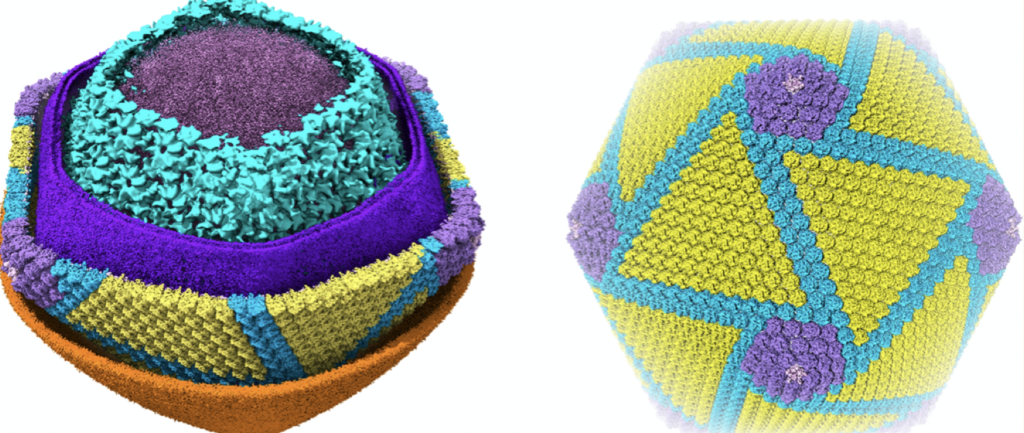
Structure of African swine fever virus elucidated
RAO Zihe and WANG Xiangxi from the CAS Institute of Biophysics and BU Zhigao from the CAS Harbin Veterinary Research Institute have determined the structure of the African swine fever virus (ASFV) at a resolution of 4.1-angstroms, using an optimized image reconstruction strategy. The virus’s structural details will provide strategies for vaccine development.
CAS news release, January 16, 2020
Tsinghua University establishes Institute of Chinese Medicine
The institute located at the College of Pharmacy of Tsinghua University aims to create a cross-disciplinary, multi-integrated and distinctive international leading traditional Chinese medicine research platform based on Tsinghua's high provile and scientific research...
CAS Guangzhou Institute of Biomedicine and Health team claims chemical Induction to obtain pluripotent stem cells
The group of DUAN Qingqing claims to have developed a highly efficient and simple chemical method using small molecules to induce pluripotent stem cells from somatic cells, abbreviated as CIP (Chemical Induction of Pluripotency). Somatic cells only need a bath" with...
China develops drilling ship capable of reaching about 10 km below seabed
The design for the ship-named Dream-is expected to be finalized this year, and the 35,000 metric ton vessel might be launched around 2021. The Dream" will become the world's third scientific drilling ship in active service after the JOIDES Resolution and Chikyu, both...
China vows to promote international mega science projects
China will incubate several international mega science and engineering projects in the future, some of which will be upgraded into China-led global projects aimed at tackling the world's most difficult scientific challenges. By 2020, China plans to create three to...
CAS Shanghai Institute of Ceramics developss fire alarm wallpaper””
The wallpaper, developed by Ying-Jie ZHU at the CAS Shanghai Institute of Ceramics, is based on ultralong nanowires made of hydroxyapatite which give the material a high flexibility. The thermosensitive sensor is loaded on the surface by a simple drop-casting process...
Unmanned submersible Hailong 11000 completes first sea test, will attempt a dive at 11000 m soon
The submersible entered the 410-meter-deep sea area from the Chinese research vessel Dayang Yihao (Ocean No. 1). It is able to dive to a depth of 11,000 meters and will complete an 11,000-meter-deep sea test within three years. Dayang Yihao carries advanced scientific...
After 2024, China may have sole space station
In 1995, China was left out of the International Space Station (ISS) project involving 16 countries and started own developments. China now owns research technology of the whole space station system, and it is possible that China's space station will be the only...
Chinese team engineers pig model of Huntington’s disease by CRISPR-Cas9 gene editing
A team of Shihua LI at Emory University, Liangxue LAI at CAS South China Institute of Stem Cells and Regeneration Medicine, and Sen YAN at Jinan University used the CRISPR/Cas9 gene editing technique to introduce a segment of a human gene causing Huntington’s, with a...
Chinese Academy of Sciences launches pilot project on organ reconstruction and manufacture
On March 26th, CAS launched the Strategy Pilot Project of Science and Technology" (A Class) in Beijing. The project networks between the CAS Institute of Stem Cell and Regenerative Medicine Innovation, and various CAS teams in interdisciplinary fields of materials...
CAS Dalian Institute of Chemical Physics achieves visible light-driven C−H activation and C–C coupling of methanol into ethylene glycol
As an important base chemical, ethylene glycol is not only the main raw material of PET, an important plastic product, but also widely used in other fields of the chemical industry. At present, more than 90% of ethylene glycol production in the industry is through the...
CAS Institute of Psychology analyzes culture and cooperative behavior patterns in belt and road areas using big data on Twitter
The team of ZHU Tingxuan at the Institute of Psychology, CAS, combined cultural psychology and big data analysis (Twitter), to analyze the characteristics such as independence or individualism of countries or regions along the belt and road initiative. The world...
Triboelectric nanogenerators (TENG) may power portable and wearable electronics: CAS Institute of Semiconductors
The group of XU Yun at CAS Institute of Semiconductors and GAO Qianqiang at Buffalo University have engineered a flexible TENG based on crumpled gold films. By introducing crumpled morphology onto the gold thin film using macrocontrol, the TENG delivered a maximum...