
Shandong Province starts hot water supply for heating by a nuclear power plant in Yantai
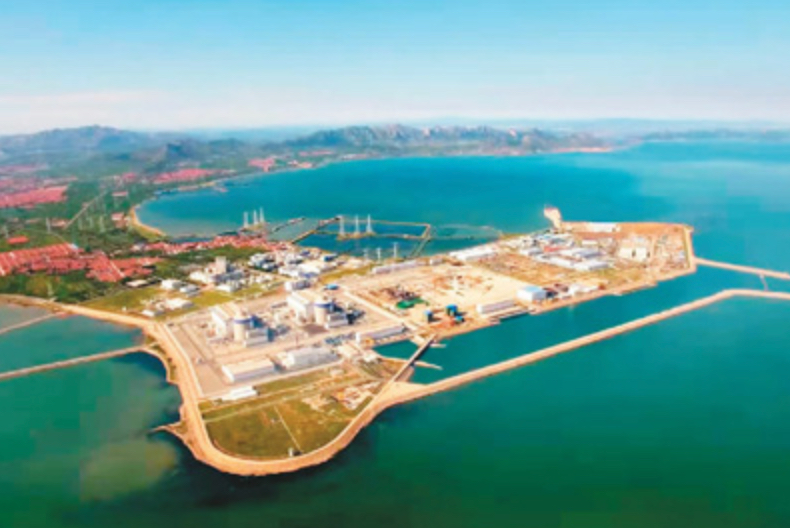
The Haiyang Nuclear Power Station in Yantai has initiated hot water supply to households, substituting hot water generated in a coal-based thermal power generator. It will initially provide heating for an area of 700,000 m2, covering the dormitories of its employees and about 30 other neighborhoods. As a heat source, steam from the loop of reactor 2 is used. Heat exchange is repeated at a heat exchange station of the heating company outside the power plant, and finally the heat is delivered to each household through the municipal heating pipe network.
Xinhuanet news release, December 11, 2019
China’s underwater glider Haiti 1000 (SeaWing) completes 1884 km voyage
Developed by the CAS Shenyang Institute of Automation, the glider moves not by a propeller, but by an oil sac like a fish maw. By changing the size of the sac, the glider can change its net buoyancy so that it can move up and down. A pair of 'wings' generates a thrust...
CAS Tianjin Institute of Industrial Biotechnology clarifies genetic evolution of alcohol fermentation in yeast
Studies have shown that a whole genome duplication event that happened around 100 million years ago played an important role in the origin of aerobic fermentation in Saccharomyces.Two groups at CAS Tianjin Institute of Industrial Biotechnology have now shown that,...
Genetic information of 40,000 year old „Tianyuan Man“ shows he is distant cousin of Goyet Caves man in Belgium
Studies by FU Qiaomei at CAS Institute of Paleoanthropology on ancient DNA extracted from 40,000 years old human bones found near Beijing have shown that the „Tianyuan Man“ inherited about as much Neandertal DNA, 4% to 5%, as ancient Europeans and Asians of similar...
CAS Institute of Microbiology joins international network on microbial genomes
Organized by the World Data Center for Microorganisms and microbial data centers in 11 other countries including DSZM in Germany, the program of the cooperation is to sequence over 10,000 microbial genomes within 5 years, finally covering over 90 % of all microbial...
2016 China’s R&D expenditure was 2.1 % of GDP
From the total expenditure of 1567.7 billion Yuan (+ 10.6 % compared to 2015), 5.2 was spent for basic research, 10.3 % for applied research, and 84.5 % for investments and infrastructure. Industry supplied 77.5 %, the central government 14.4 %, and local units 6.8 %....
China’s stem-cell related industry shows healthy growth
According to a survey by Sina Publisher, China at present has over 100 different stem cell industry-related enterprises. Since 2011, when the State Health Commission and the Food and Drug Administration jointly stopped stem cell clinical research and application...
China launches unhackable Beijing-Shanghai quantum link
The system is based on Micius, the world's first quantum communication satellite, which was launched by China in 2016. In the near future, the backbone of this system will connect Beijing, Shanghai, Jinan (Shandong province) and Hefei (Anhui province). Mr BAI Chunli,...
Nuwacell prepares for clinical studies on hematopoetic iPS cells in 2018
The company http://www.nuwacell.com was founded in January 2016 in Hefei, Anhui Province, and chairman of the board is Dr. Yu Junying. As a graduate of Peking University, she got her Ph. D. from the University of Pennsylvania and was a post-doc with James Thomson at...
China sets up 10 pilot programs, will establish national park system by 2020
The State Council has ordered all its provinces and regions to establish an ecological "red line" that will declare designated regions under mandatory and rigorous protection. The 10 pilot programs include Sanjiangyuan (the source of China's three major rivers), giant...
Merck KGaA opens BioReliance Biodevelopment Center in Shanghai
The center offers competencies and services for bioprocess development, e. g., for the development of cell lines, and upstream and downstream processes. Target customers are SMEs in the Asia-Pacific region which work on clinical studies in an early phase. China Bio...
China plans to complete National Technology Transfer System by 2025
The State Council will establish, by 2020, a national technology transfer system with the objective to support China's efforts to become a leading power in science and technology. Key feature is a more unified and open technology market and exchange network on the...
China’s vaccine industry: 64 kinds, 25 billion Yuan sales
China implemented a child immunization program in 1978 which is steadily expanding. In early 2017, there were 43 approved vaccine companies, accounting for 40% of the global vaccine production enterprises. About 300 companies are involved in vaccine R&D, including...