
Chinese gravity wave project (“Lyra project”) enters stage of space test
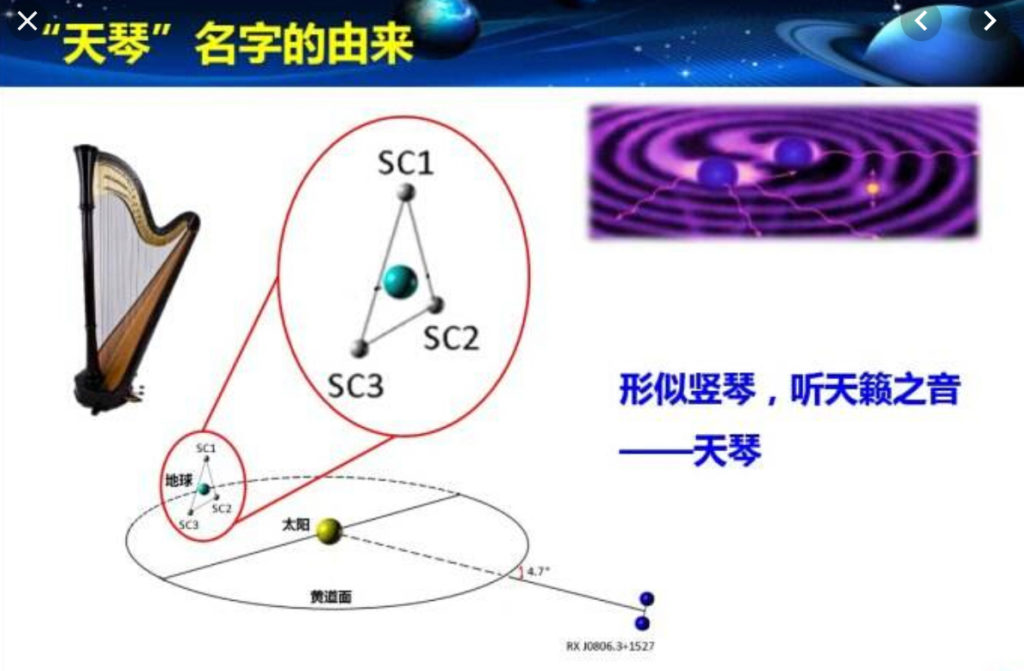
The “Lyra project” was initiated by the CAS in March 2014, after basic research in a cave laboratory at Huazhong University of Science and Technology by Mr LU Shun in 1994. According to the plan, around 2035, three satellites will be placed in an orbit approximately 100,000 km away from earth to form an equilateral triangle with a side length of approximately 170,000 km. This setup will serve as a gravitational wave observatory in space and explore gravitational waves. On December 20, a Long March No. 4B carrier rocket launched a “Lyra-1” satellite and started the space test phase.
Xinhuanet, December 23, 2019
China’s Chang’e 5 lunar probe to bring back lunar samples.
Chang'e 5, China's newest lunar probe, is scheduled to bring 2 kilograms of lunar soil and rock samples back to Earth before the end of 2017. The 8.2-metric ton probe has four components, an orbiter, lander, ascender and re-entry module. After the probe reaches lunar...
Wuhan P4 biosafety laboratory jointly built and operated with France
French Prime Minister Cazeneuve participated in the opening ceremony of the laboratory on March 2. In design, it is similar to the French Lyon P4 laboratory. It will provide a complete advanced biosafety system and become China's infectious disease prevention and...
China plans to explore asteroids and land on one
The target asteroid for landing is Aphobis, an asteroid of about 400 m length, which will come close in 2029, missing the earth by about 30,000 kilometers. In 2012, China's second lunar probe, Chang'e-2, after successfully completing its mission, rendezvoused with the...
Team at South China Agricultural University explores animal saliva for transgenic protein production
The group of Zhenfang WU has produced nerve growth factor in the salivary glands of transgenic mice. Within a state-funded project, the team explores if saliva from transgenic animals such as pigs might become a commercial production method for therapeutic proteins,...
Hefei starts construction of comprehensive national science center
CAS Hefei Institute of Physical Sciences has already built 3 large-scale scientific units: a synchrotron, a superconducting tokamak and a steady-state strong magnetic field device. Next to Beijing, it is among the country’s most densely populated science areas. The...
iGene Technology Co. to develop a genetic testing device “made-in-China”
The instrument will be based on iGene’s liquid chip probe hybrid gene capture technology TargetSeq and multiple PCR amplification technology MultipSeq. It aims at enterprises, hospitals and research institutions interested to customize and develop genetic testing...
CAS Institute of Biophysics researcher proposes new concept of aging based on “redox-stress response capacity” (RRC)
Prof. Chang CHEN has proposed a new concept based on studies with C. elegans and human fibroblast senescence cells. His results showed that compared with old worms or senescent cells, young worms or young cells could generate more reactive oxygen species (ROS) to...
China’s acreage for transgenic cotton production reaches 3,37 million ha
China’s largest cotton-producing area is Xinjiang, with about 1,8 million ha. According to the Ministry of Statistics, the cotton-producing area was down by over 11 %, but the the cotton production in Xinjiang alone reached 3.594 million tons and will eventually...
China’s technology trade in 2016 reached 1.14 trillion Yuan (166 billion USD)
According to the Ministry of Science and Technology, 80 % of this budget targeted Information technology, advanced manufacturing, new energy, biomedicine and other high-tech fields. It was announced that China will build new technology sharing platforms for...
CAS Institute of Materia Medica discovers potential boost for Olaparib in triple-negative breast cancer
Scientists from Shanghai Institute of Materia Medica (SIMM) of Chinese Academy of Sciences discovered a role of the metabolic enzyme phosphoglycerate mutase 1 (PGAM1) in maintaining genomic stability, and found that PGAM1 inhibitors have the potential to expand the...
Graphene oxide may be useful for cryopreservation
The ordered arrangement in antifreeze-proteins of the hydrophobic and hydrophilic functional groups protruding in the ice-binding phase facilitates the formation of ice like water, which provides the driving force for binding to the ice surface and inhibits the growth...
China joins International Ocean Discovery Program (IODP) and builds field laboratory in the NE South China Sea
The IODP program will involve 33 scientists, 26 from China, others from the US, France and other nations. The scientists will explore the lithosphere extension during the continental breakup, by drilling four sites to a depth of 3,000 to 4,000 meters in the northern...