
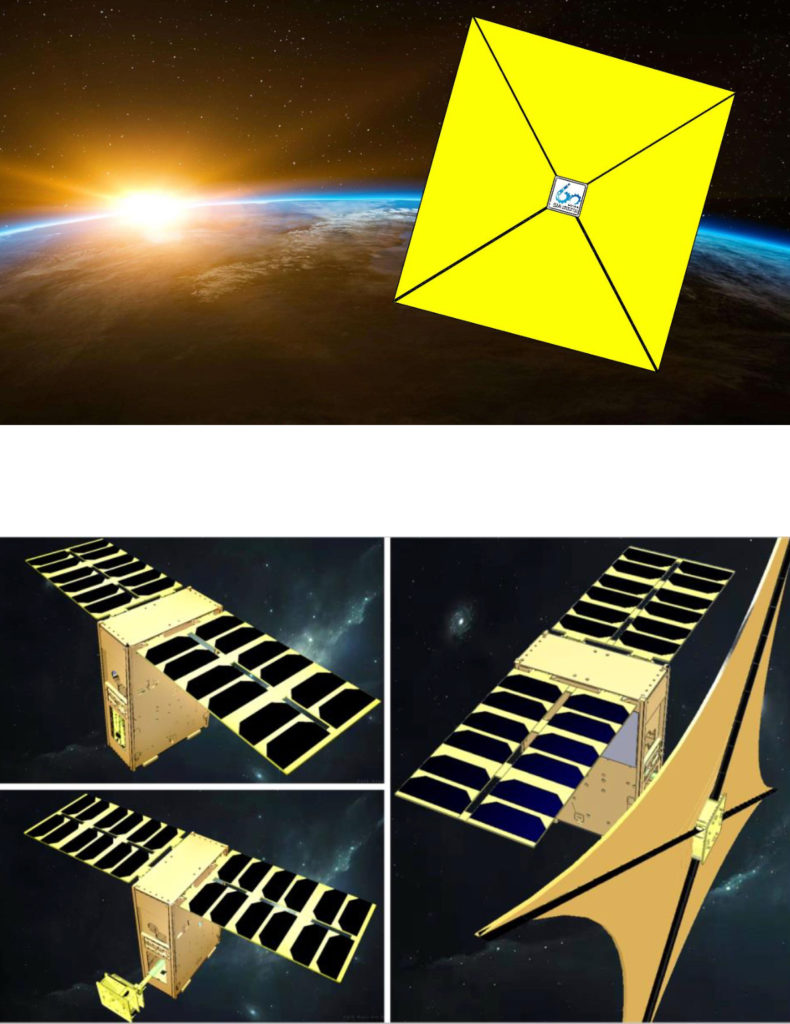
CAS Shenyang Institute of Automation achieves first success in solar sail technology
The solar sail is a spacecraft powered by the reflected light pressure of the sun on the film. It does not consume additional chemical fuel during the voyage. Features are a small mass, low cost, low power consumption, and long range. “Tianfan-1″ is a solar sail developed by the CAS Shenyang Institute of Automation and was launched by a Xiaoxiang-1 satellite 07 on August 31. “Tianfan-1” has recently carried out a series of key technical tests on unfolding and assembling and will provide technology for solar sail research and development at a larger scale.
CAS news release, December 30, 2019
CAS QIBEBT develops Raman-activated droplet sorting (RADS) for functional cell screening
Using astaxanthin-producing Haematococcus pluvialis microalgae as a model organism, a device was constructed where Raman-activated cell-sorting is followed by microdroplet encapsulation, followed by dielectrophoretic separation of individual cells (up to 260...
China upgrades Beidou satellite system for global reach
Two 3d generation Beidou satellites, the first of their type, were launched by a Long March 3B carrier rocket from Xichang Satellite Launch Center in Sichuan province on Nov. 5 and were placed in medium Earth orbit. The new-generation satellites feature better...
Fraunhofer IPK, Haier and Qingdao Sino-German Eco-Park cooperate on smart manufacturing
The contract relates to the „Made-in-China 2025 Innovation Center Cooperation Agreement“ signed in June 2017 by the Ministry of Industry and Information Technology and the Fraunhofer Institute for Production Systems and Design Technology in Berlin. Both parties will...
Rechargeable Zn-air batteries may offer new opportunity for water-to-hydrogen splitting
In the new concept, the oxyen evolution reaction is replaced by a thermodynamically more favourable urea oxidation reaction. A consortium from CAS Institute of Physical Science designed a Ni2Mn-Hy/CFC electrode with urea oxidation activity, which was assembled as...
Inner Mongolian ruins confirmed by C14-dating of middle paleolithic age
By carbon-14 dating of remains in stoneware found at ruins at Sanlong Mountain in Ar Horqin Banner, the ruins were dated as at least 50,000 years old, from the middle-paleolithic period. The stoneware includes tools with sharp ends or edges believed to have been used...
China leads in global production of pantothenic acid
Panthothenic acid is a water-soluble vitamin (vitamin B5) and an essential nutrient. Animals require pantothenic acid to synthesize coenzyme-A (CoA), as well as to synthesize and metabolize proteins, carbohydrates, and fats. Major producer is Xinfa Pharmaceuticals,...
Consortium develops and demonstrates Agility Skeletal Robot
The exoskeleton is designed for the elderly and the disabled with weakened motor function and mobility. The robot recognizes human intentions and coordinates man-machine interactions. The device was jointly developed by CAS Hefei Institute of Material Science, CAS...
CAS team completes genome analysis of coconut
Scientists from the Chinese Academy of Tropical Agricultural Sciences sequenced and assembled the genome of the coconut. They identified 282 unique gene families and started to analyzed their function. CAS news release, November 2, 2017
Chinese consortium publishes blue book on medical equipment
The China Medical Device Industry Development Report (2017)" was compiled by over 70 experts from administrative departments, industry associations, universities and enterprises and analyzes the current situation of China's medical device industry, as well as the main...
Blue Biomedical Industry Park in Qingdao starts operation
The incubation center has attracted 83 innovative enterprises, making up more than 70% of the overall occupancy. In addition, a service platform for more than 100 professional services has been established. On an area of 2,800 square meters, Shandong University of...
State Council boosts Industry 4:0
China will accelerate the development of the internet working with advanced manufacturing to boost innovation and entrepreneurship and the integration of enterprises of various sizes to advance the upgrading of the economy. The decision was made at a State Council...
China counts over 500 CRO organizations, half in biomedicine
As of September 2017, there were 525 CROs in China, of which 248 were clinical service enterprises and 262 non-clinical service enterprises. Location is mainly in Beijing, Shanghai and Jiangsu. 2004-14 was the peak period of CRO development, mainly benefiting from new...