
CAS Dalian Institute of Chemical Physics group constructs microbial cell which turns CO2 into malate by reductive carboxylation
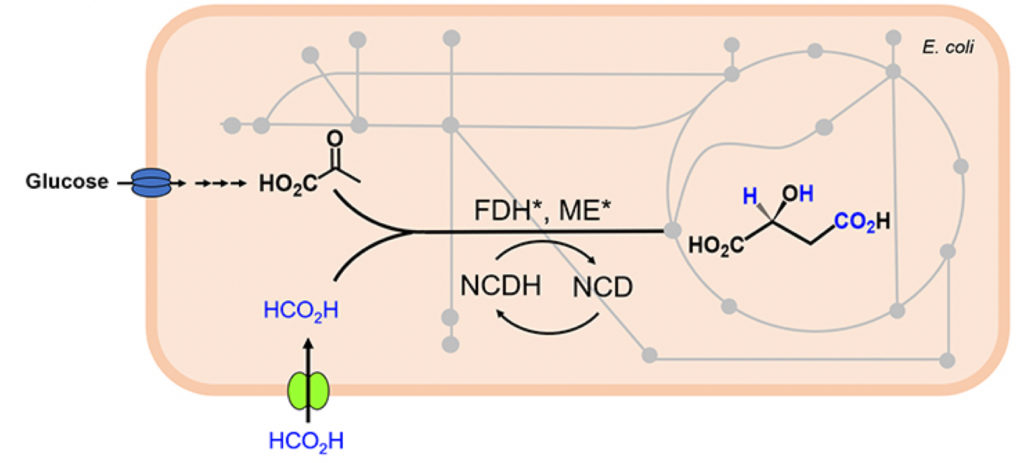
The group of ZHAO Zongbao has built an E.coli cell which uses a non‐natural cofactor and formate driven system for reductive carboxylation of pyruvate. To this end, a formate dehydrogenase (FDH) mutant, FDH*, that favors a non‐natural redox cofactor, nicotinamide cytosine dinucleotide (NCD), generates a dedicated reducing equivalent at the expense of formate. By coupling FDH* and NCD‐dependent malic enzyme (ME*), the successful utilization of formate as both CO2 source and electron donor for reductive carboxylation of pyruvate was shown, with a perfect stoichiometry between formate and malate.
https://doi.org/10.1002/ange.201915303
Waste oil will stimulate change to biokerosene
China presently consumes over 2 billion tons of aviation fuel per year. IATA preducts that by 2020 bio-kerosene will reach 30 % oft he total aviation fuel. Recently, Sinopec at its Zhenhai Refining and Chemical Branch has also expanded the production of bio-aviation...
Phosphorescence might open avenue to all-weather solar cells
According to Peizhi YANG at Yunnan Normal University, his solar cell based on long-persistent phosphor (LPP) could store sunlight energy in the day and harvest in darkness. All-weather solar cell, comprise a CQD-sensitized mesoscopic titanium dioxide/long-persistence...
China Aerospace Science & Industry Co. (CASIC) will launch 156 mini-satellites
State-owned China Aerospace Science & Industry Corporation (CASIC) have announced plans for a network of 156 mini-satellites to facilitate global broadband coverage. The low orbiting, networked satellites will orbit 1,000 km above the ground and launched between 2018...
Nanjing will build China’s largest human genome sequencing center
The Nanjing Yangzi state investment group will create a laboratory with a total area of 200,000 m2 and settle China's first national health medical data center in this location. At present, the center has 10 Hiseq X-ten high-throughput sequencers in operation. With...
NNSF Foundation funded projects of nearly 27 billion Yuan in 2016
In 2016, the National Natural Science Foundation (NNSF) funded 41,184 projects, with a total funding for equipment, materials, travel costs and other direct costs 22.706 billion Yuan. Indirect costs for for project organization were 4.1 billion Yuan. in 2016, the...
CAS QIBEBT tests solid-state lithium batteries at 7,000 m depth
In conjunction with China’s deep sea exploration program, the institute has developed a solid lithium battery with an energy density up to 300Wh/kg which was tested during 9 dives greater than 7,000 meters, of which 6 were more than 10,000 meters, and the maximum...
Beijing Municipality establishs stem cell and regenerative medicine research” special expert group”
At the inauguration, it was stressed that the project should give full play to the advantages of Beijing, e. g., the strong support for the construction of the National Science and Technology Innovation Center, the integration of the military, and the advantages to...
AG600 Amphibious aircraft prepares for maiden flight, 17 orders received
The aircraft was developed by the Aviation Industry Corporation of China. Similar in size to a Boeing 737, it has a maximum range of 4,500 km and was made with the purpose of fighting forest fires and performing marine rescues. It can collect 12 tons of water in 20...
CAS Tianjin Institute of Industrial Biotechnology develops biosensor for analysis of metabolic pathways
The group of ZHANG Dawei has developed a biosensor which monitors a set of transcriptional regulators responding to intracellular phenylalanine concentrations via a fluorescent signal. The sensor was used to monitor bacteria engineered for overproduction of...
Shanghai Rainbow Fish Marine Technology Co. and Shanghai Ocean University open “marine abyss center”
The center contains specimen collected in the South Pacific at depth from 6,500 to 10,900 m depth and will build a unique database for microbial resources and large data. China Bio news release, March 28, 2017
CAS Ningbo Institute of Materials Technology and Engineering establishs improved technology for boron nitride nanosheats (“white graphene”)
Hexagonal boron nitride nanosheets, also known as white graphene", has similar properties to graphene, such as excellent mechanical stability and thermal conductivity. Using ultrasonic separation and cheap raw materials, boron nitride nanosheets with an average...
China’s underwater glider Haiyi reaches 6,329 m depth
Haiyi (sea wings") is made from carbon fiber and was built at CAS Shenyang Institute of Automation. It can monitor sea water temperature, salinity, turbidity, chlorophyll and oxygen content. Haiyi does not have a propeller. In its body, there is an oil bag that works...