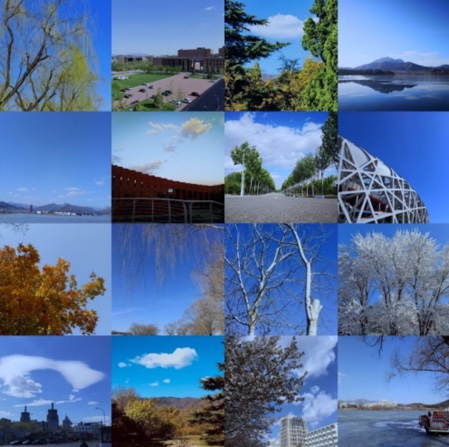
China is often troubled by haze pollution from accelerating industrialization, in Beijing also from desert dust. As a result, air pollution control has become an important issue, as symbolized by the keyword “Beijing blue” for blue skys in Beijing.
Scientists from the CAS Institute of Atmospheric Physics and Peking University have now defined a Chinese blue days index, which contains a double meanings of sunny days and clean air. The index combines meteorological and environmental data and shows a steady increase in Chinese blue days (CBD) during 1980-2014. Three low-value centers can be found in the southeast Sichuan Basin, southern Hebei, and northeast Guangxi, with annual mean average CBD of 74, 86 and 92, respectively. The minimum/maximum trends (-7.5/9.5 d/10y) appeared in Yangtze-Huai River Valley (YHRV) / southwestern China (SWC). Approximately 42% of stations showed a prominent, increasing trend and approximately 23.4% of stations showed a decreasing trend.
CAS news release, August 31, 2019